
European Employment Insights: September 2026 – An Overview of Changes in the Law, Case Law, and Practice
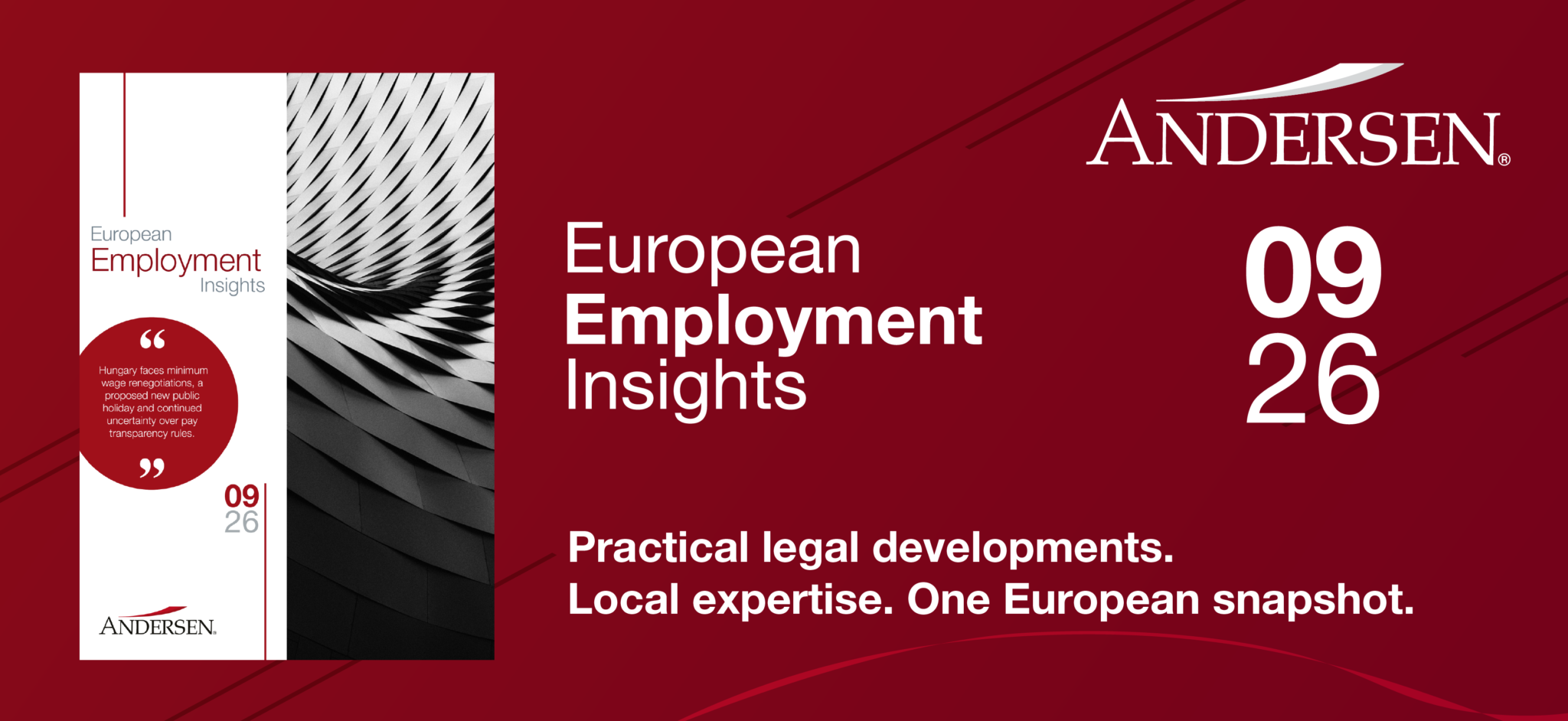
In the September issue of Andersen Employment Insights, experts from 17 European countries examine changes in the law, case law, and practice that influence employers’ decisions.
Here are a few topics particularly worth noting:
- Pay transparency is becoming an increasingly common part of everyday HR practice. Greece has implemented the EU Pay Transparency Directive. In Moldova, meanwhile, further requirements are being drafted regarding employee categories, pay ranges, variable pay components, and pay progression rules.
- The status of platform workers. The Portuguese Supreme Court ruled that a courier delivering meals via an app (Uber Eats) is an employee, not an independent contractor. The court confirmed that the control exercised by the platform and its algorithms meets the legal criteria for an employment relationship.
- Worker mobility. Belgium has changed the rules regarding people who work in Belgium but still reside in a neighboring country. Meanwhile, in Croatia, some third-country nationals are now required to undergo a medical examination when renewing their temporary residence permit.
- Partial sick leave. In Germany, plans are in place to introduce, starting in 2027, the option for employees on long-term sick leave to work part-time (25%, 50%, or 75%). However, this arrangement will require the employer’s prior consent.
Partner Spotlight: Denmark
This month, we’re also taking a look at the Danish labor market model—and a question that can be surprisingly difficult for a foreign employer:
Since there is no statutory minimum wage in Denmark, how much should a posted worker be paid?
Helle Melgaard, Global Mobility Legal Advisor at COMPA Mobility ApS, explains how to navigate collective bargaining agreements, Danish salary benchmarks, posting allowances, and immigration requirements when posting employees to Denmark.
Poland – Key Insights
- First interpretations by the Chief Labor Inspector regarding the use of civil law contracts instead of employment contracts
- A new, 30-point PIP checklist for assessing whether a civil law contract should be replaced with an employment contract
- Higher penalties associated with the PIP’s new powers—provisions regarding their amounts have been referred to the Constitutional Tribunal
- An accident on the stairs leading to the production hall may be considered a workplace accident
These are just some of the changes discussed in the September issue. 17 jurisdictions, local expertise, and a practical look at European labor law and Global Mobility, plus a Partner Spotlight on the specifics of the Danish labor market.
We encourage you to read the full issue of the newsletter – LINK
If you have any questions, please contact Magdalena Patryas or Katarzyna de Rosset.
KONTAKT

E: magdalena.patryas@pl.Andersen.com
T: +48 32 731 68 84
M: +48 502 392 419

E: katarzyna.derosset@pl.Andersen.com
T: +48 22 690 08 88